Artist Statement
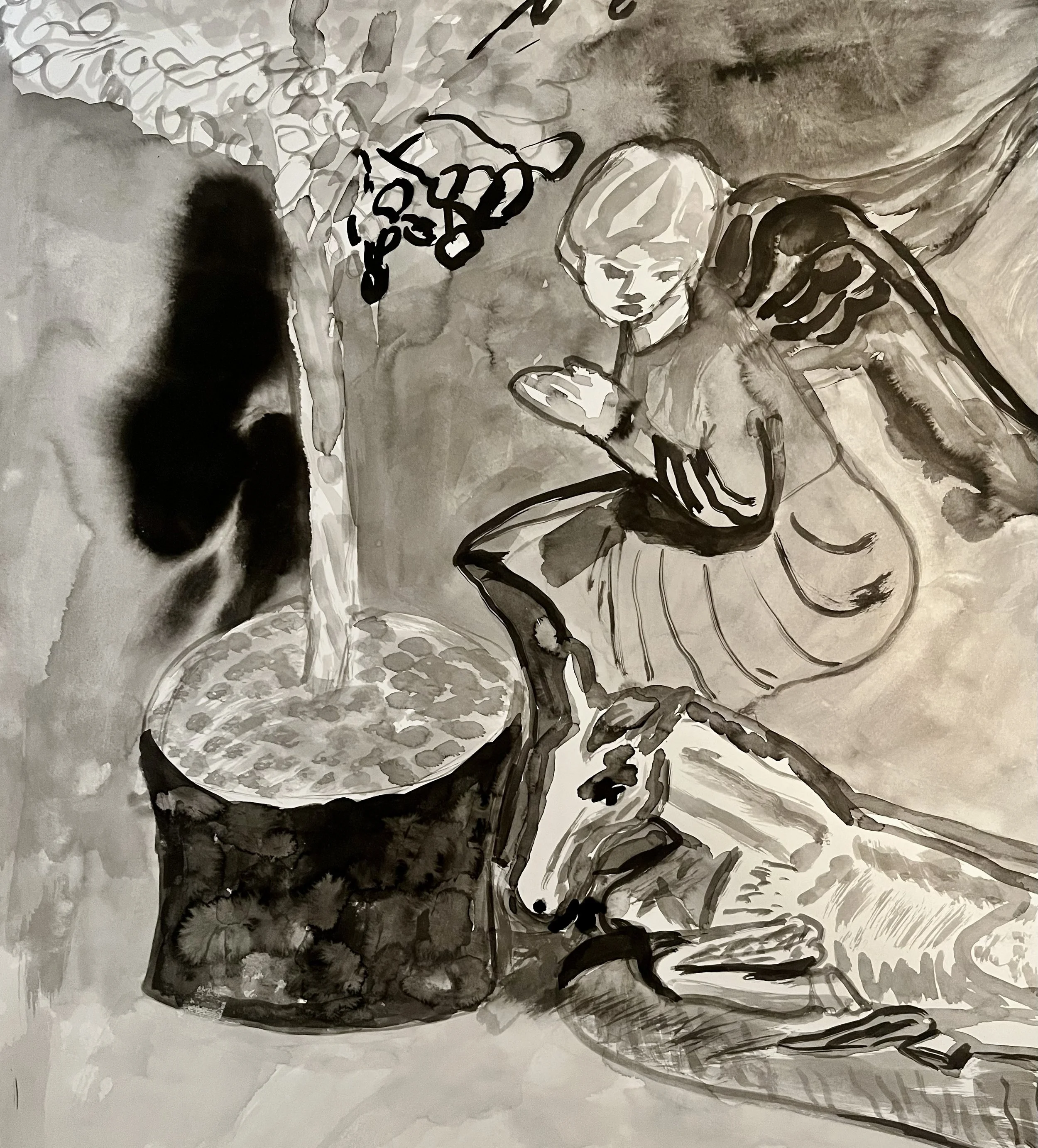
My current work centers on found Nativity figurines, which I use as recurring source material for painting. These archetypal characters, now joined by wedding cake topper couples and a makeshift "tree of life," allow me to stage invented dramas through the prefab forms of the popular imagination. I reinterpret and recast them through color, composition, and unexpected combinations. An expanding collection of rustic barns provide the playhouse where this growing ensemble performs. The entire set becomes a kind of spiritual dollhouse that I imagine expanding indefinitely, both as a collection and as a creative universe.
This exploration began unexpectedly with the discovery of a few stray Nativity figurines at a local thrift store. Finding two different baby Jesuses and a loose Wise Man inspired me to reassemble them into a new composite family, initially for my own amusement. What began as a private collection soon revealed itself as a rich source of material for painting.
I am drawn to the symbolism of the divine child born in the humblest of places, to the interplay of the everyday and the mythic embodied by these collectible objects, and to the distinctive details of each miniature figurine, both familiar and surprising, each reflecting the unconscious imaginings of its manufacturer. The presence of animals in the scene is particularly compelling to me. They function as instinctive and grounding bodily presences within the spiritual narrative, balancing the compositions both visually and conceptually. They puncture the solemnity of the atmosphere, introducing a dream-like comic element.
Working from a cast of figurines is like directing a film in paint. They become my actors or, to steal Robert Bresson's term, my "models." Like Bresson's models, the figurines embody grounded, tangible presences that allow for a continual interplay between observation and invention, between still life, portraiture, and mythological narrative. By including details such as the molded grassy bases the figures stand upon, as well as comparatively larger elements like my own hand, I underscore their miniature scale. I want to make clear that these are not flesh-and-blood actors but small stand-ins for the mythic.
Color is an equally active force. Josef Albers described painting as "color acting," with each color an "actor" and the composition its "performance." My paintings bring these two forms of acting together: the figurines onstage and the colors that animate their drama.
These paintings are an exploration of love, faith, divinity, creation, the endlessly adaptable idea of family, and the unknown. My cast of characters, including multiple Marys, Josephs, baby Jesuses, angels, animals, wise men, and other supporting characters, becomes a kind of biblical Brady Bunch, allowing the sacred and the ordinary, the sincere and the absurd, to coexist. Coming from a family that often felt fractured, I find the idea of bringing together these orphaned figures especially compelling. In my paintings, they are continually reassembled into new blended families, scenes, and relationships, suggesting that belonging can be assembled in many configurations.
Coming to this Christian imagery from a Jewish background, I also think of Barbra Streisand recording Christmas albums and of the fact that many of the most iconic Christmas songs were written by Jewish songwriters. I am drawn to the sense of lineage that comes from working within biblical stories, one of the foundational subjects of Western painting, which countless artists have interpreted and reimagined in their own ways. The divine birth, the mother and child, the family unit, and the relationship between spirit and matter are primal symbols that continue to resonate across time, culture, art, and human life.
In researching Nativity paintings, I learned that they were often created as intimate devotional tools, encouraging believers to contemplate the birth of Christ as a path toward closer communion with God. To meditate on the Nativity was believed to awaken one's own spiritual rebirth. I am inspired by the relationships between prayer and painting (Susan Rothenberg contended that paintings themselves are prayers), and by the possibility that my own work might hold a similar devotional function, offering some kind of renewal or expansion not only for myself as the maker, but also for those who encounter the work. For me, this renewal is not dogmatic or prescribed by doctrine. It arises through an open-ended process of playing with "dolls" and wrestling with the unknown in the muckiness and mystery of paint, character, and relationship.
There is something strangely compelling for me about expressing the transcendent through objects so small and artificial, and about painting observationally from physical objects that resist naturalism. I collect orphaned figurines, broken away from their original sets, and collage them into new constellations, reassembling the family as a symbolic gesture of healing. These cast-offs provide a point of departure, offering familiar forms that I can direct in my own narratives, complete with crossover characters from other archetypal plotlines. I see endless possibilities for this body of work and for the continued play of characters, configurations, and adaptations.